
By Bruno Cerqueira, Agrupamento de Escolas de Valdevez, Portugal
During my recent Erasmus+ mobility in Graz, Austria, I had the privilege of working closely with both students and teachers, sharing knowledge and practical applications of Artificial Intelligence in education. This experience was not only professionally enriching, but also personally inspiring.
I am an ICT teacher and teacher trainer from Portugal, with over two decades of experience in education. Throughout my career, I have worked with a wide range of learners — from young students in secondary and VET education to adult learners and fellow teachers in professional development contexts. My work is driven by a deep passion for educational technology, digital transformation and, more recently, the integration of Artificial Intelligence in teaching and learning.
During my stay in Graz, I conducted workshops with six different student groups, each lasting approximately one hour. These sessions were designed to be practical, engaging and accessible, focusing on how students can use AI tools responsibly and effectively in their learning process. The aim was not only to demonstrate the capabilities of AI, but also to encourage critical thinking, creativity and awareness of its limitations.
In parallel, I delivered a dedicated workshop for teachers focused on one of the most relevant and emerging topics in education today: the sustainability and ethics of Artificial Intelligence. In this session, we explored the often “hidden footprint” of AI systems — including their energy consumption, carbon impact and use of natural resources — helping educators understand that digital technologies, while powerful, also have real-world environmental implications .
At the same time, I introduced and demonstrated several key AI tools that can support teaching practice in meaningful ways. These included ChatGPT, Google Gemini, NotebookLM and Gamma, tools that allow educators to create content, design lessons, differentiate instruction and provide feedback more efficiently. The focus was always on practical application, showing how AI can become a supportive partner in teaching rather than a replacement for the teacher’s role.
One of the key ideas shared throughout the sessions was the importance of prompt design, i.e., the ability to communicate effectively with AI systems.
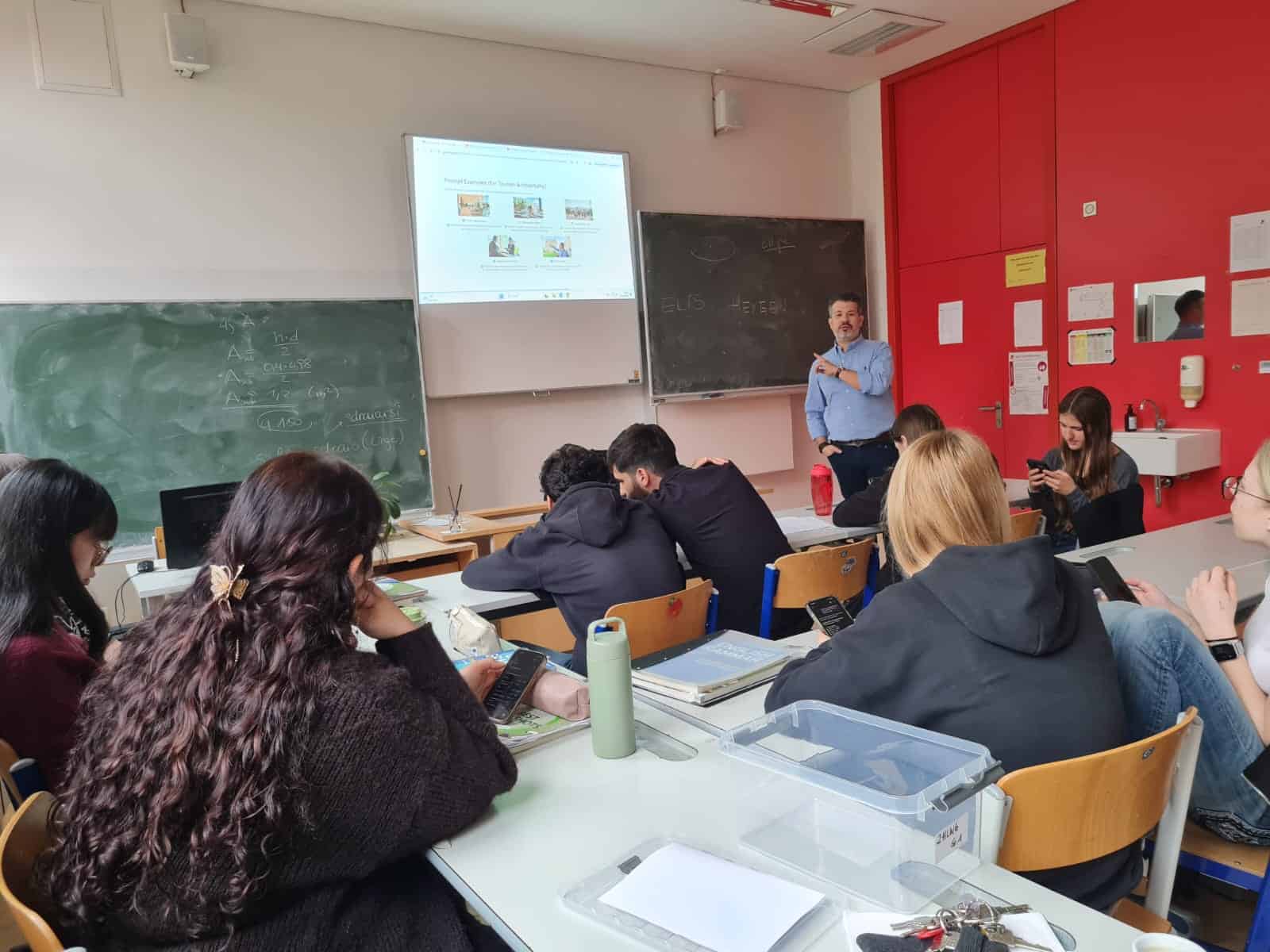
By structuring prompts clearly, with defined objectives and context, both students and teachers can significantly improve the quality of AI-generated outputs. This simple but powerful concept proved to be one of the most impactful takeaways for participants.
What made this experience truly special was the openness, curiosity and engagement of the school community in Graz. Some students were eager to explore, experiment and reflect, while teachers showed a strong interest in integrating these tools thoughtfully and responsibly into their practice.
This Erasmus+ experience reinforced a key belief that guides my work: Artificial Intelligence has enormous potential in education, but its value depends on how we use it. As educators, we have the responsibility to guide students not only in using these tools, but in understanding them, critically, ethically and sustainably.
I leave Graz with a deep sense of gratitude and inspiration, confident that these exchanges contribute to a more innovative, reflective and future-oriented education system.


